
• Welcome
  • About
  • Publications
  • Edited Special Issues
  • Research
  • Joining Policy Systems Group
  • Teaching
  • Blog
  • Contact
Menu

Araz Taeihagh

469C Bukit Timah Road
Singapore, , 259772
D.Phil. Oxon

D.Phil. Oxon

Araz Taeihagh

  • Welcome
  • About
  • Publications
  • Edited Special Issues
  • Research
  • Joining Policy Systems Group
  • Teaching
  • Blog
  • Contact

Call for papers - Quantum Computing and the City (Cities, Submission deadline: 31 October 2026)

December 11, 2025 Araz Taeihagh

Quantum Computing and the City

Submission deadline: 31 October 2026

Quantum computing represents a profound shift beyond classical computation, harnessing superposition, entanglement, and quantum tunnelling to tackle complex urban challenges that conventional systems cannot efficiently address. Its emerging applications span core urban domains: quantum algorithms may deliver real-time optimisation of metropolitan transport networks; quantum simulation could enhance climate adaptation through high-resolution environmental modelling; and quantum methods offer new capabilities for managing dynamic energy grids and integrating distributed renewables. These advances create opportunities for cities for more robust, evidence-based infrastructure planning, resource allocation, and policy design. Beyond computation, quantum sensing supports improved environmental monitoring, quantum communication enhances infrastructure security, and quantum AI enables deeper insights from large-scale urban datasets. When integrated with digital twins, intelligent grids, and emergency response systems, these technologies raise important questions about governance, regulation, equity, and institutional readiness. This special issue seeks cutting-edge research on the conceptual, technical, practical, and policy intersections between quantum technologies and urban systems, positioning quantum innovations not only as computational breakthroughs but also as potential enablers and disruptors of more adaptive, efficient, equitable, and sustainable urban futures, while recognising the new risks and trade-offs they introduce.

Guest editors:

Tan Yigitcanlar, Queensland University of Technology, Australia tan.yigitcanlar@qut.edu.au

Yuan Lai, Tsinghua University, China yuanlai@mail.tsinghua.edu.cn

Araz Taeihagh, National University of Singapore, Singapore spparaz@nus.edu.sg

Steven Jige Quan, Seoul National University, Republic of Korea sjquan@snu.ac.kr

Yanjie Fu, Arizona State University, USA yanjie.fu@asu.edu

Special issue information:

Emerging scholarship, e.g., Quantum AI Urbanism: Redefining the Future of Artificial Intelligence in Cities (Yigitcanlar et al., 2025), explores how next-generation computational paradigms may reshape urban technology, governance, and policy. Quantum computing marks a fundamental shift from classical bit-based logic by harnessing superposition, entanglement, and tunnelling to solve complex, large-scale problems that exceed conventional computational capacity. Potential applications span transport optimisation, fine-grained climate and environmental simulation, and integration of distributed renewables into dynamic energy grids. Combined with quantum sensing, quantum communication, and quantum machine learning, these capabilities open new possibilities for evidence-based urban planning, infrastructure management, and resilient policy design; while raising critical questions about governance, regulation, equity, and institutional preparedness.

This Special Issue, Quantum Computing and the City, invites cutting-edge research on full-stack quantum technologies (hardware, algorithms, sensing, communication), quantum-inspired optimisation and AI, and post-quantum cryptography—provided submissions demonstrate clear implications for urban systems, planning, policy, or governance. Purely technical papers without substantive urban relevance fall outside the scope. We welcome conceptual, theoretical, methodological, empirical, design-oriented, and policy-focused work using any methodological approach, including comparative, critical, and speculative studies grounded in urban concerns. All submissions must clearly articulate how the research advances understanding or practice in urban planning, design, governance, or management beyond generic smart-city or AI narratives.

The Special Issue aims to consolidate emerging knowledge and shape an international research agenda for quantum-enabled urbanism. By bridging urban studies, computer science, physics, engineering, and public policy, it seeks to:

  • Critically assess the promises, challenges, and limitations of quantum technologies for urban contexts.

  • Advance interdisciplinary understandings of quantum-enabled urbanism and its wider implications.

  • Showcase pioneering quantum AI applications, experimental implementations, and urban policy-relevant case studies.

  • Stimulate debate on responsible, ethical, and equitable deployment of quantum technologies in cities.

  • Develop a forward-looking roadmap for integrating quantum technologies into urban innovation, planning, and governance.

  • Explore the societal, economic, and environmental implications of quantum technologies for sustainable urban futures.

  • Foster collaboration between researchers, policymakers, and industry to accelerate practical and inclusive quantum urban solutions.

Manuscript submission information:

You are invited to submit your manuscript at any time before the submission deadline, 31 October 2026. For any inquiries about the appropriateness of contribution topics, please contact Prof. Tan Yigitcanlar via tan.yigitcanlar@qut.edu.au.

The journal’s submission platform (Editorial Manager®) is now available for receiving submissions to this Special Issue. Please refer to the Guide for Authors to prepare your manuscript, and select the article type of “VSI: Quantum Computing and the City” when submitting your manuscript online. Both the Guide for Authors and the submission portal could be found on the Journal Homepage here: https://www.sciencedirect.com/journal/cities

All the submissions deemed suitable to be sent for peer review will be reviewed by at least two independent reviewers. Upon its editorial acceptance, your article will go into production immediately. It will be published in the latest regular issue, while be presented on the specific Special Issue webpage simultaneously. In regular issues, Special Issue articles will be clearly marked and branded.

Keywords: Quantum urbanism; Quantum-enabled cities; Algorithmic urbanism; Quantum infrastructure; Responsible quantum AI; Ethical quantum sensing; Beyond smart cities; Urban planning and policy; Urban governance
In call for papers, Cities, Governance, Research, Technology Tags Call for Papers, Quantum Computing, Cities, Smart cities, smart city

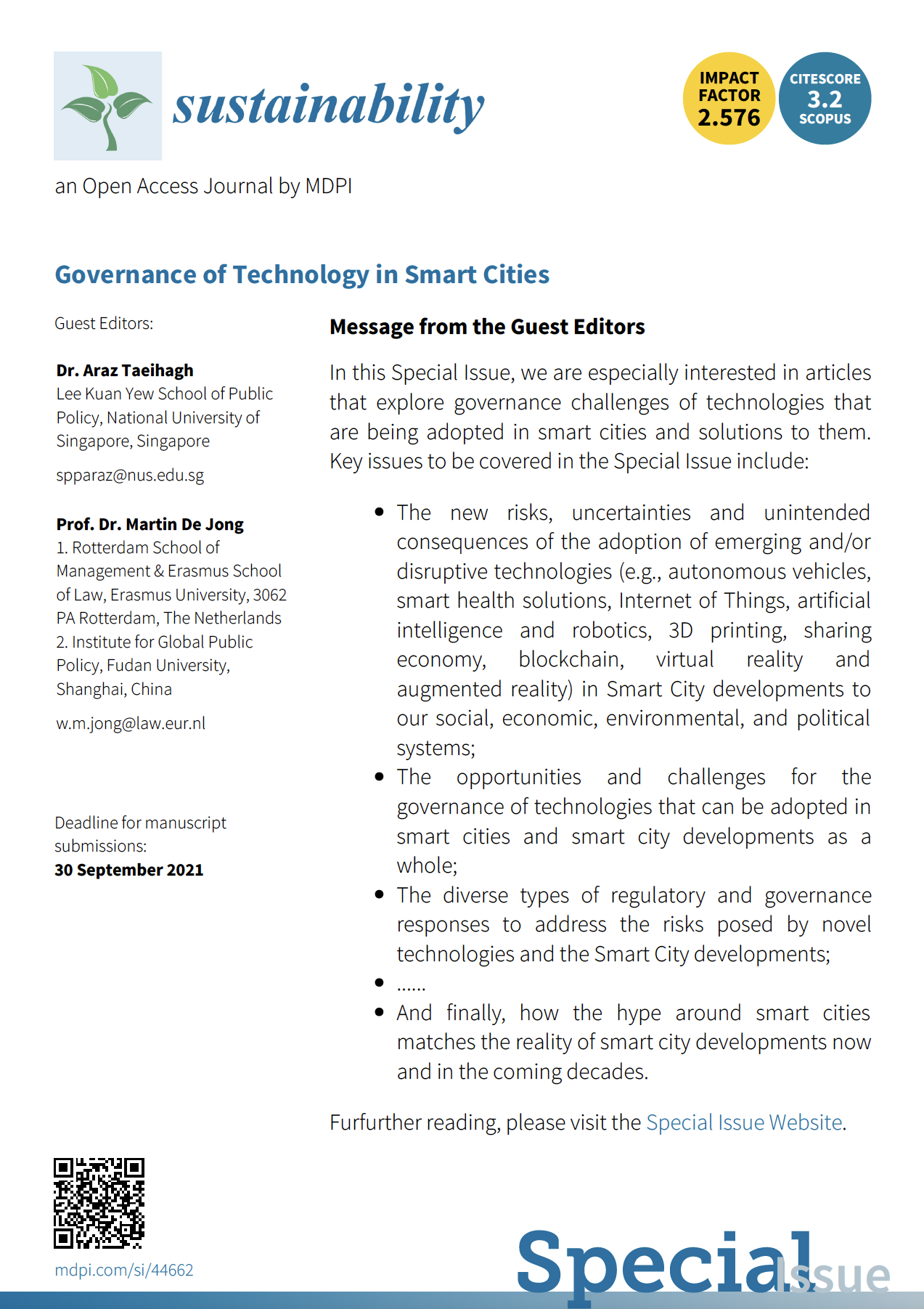
Call for Paper: Special issue "The Governance of Technology in Smart Cities"

January 19, 2021 Araz Taeihagh
Governance of Technology in Smart Cities. Eds: Taeihagh and de Jong

CALL FOR PAPERS - Governance of Technology in Smart Cities. Deadline 30 April 2021. https://mdpi.com/si/44662 #smartcities #technology #governance #infrastructure

Read More
In Cities, Governance, Sustainable development, Technology, Transport, Research Tags Call for Papers, Smart cities, Platforms, Urban governance, Infrastructure systems, infrastructure, Innovation, regulation and governance, Transport, Transit oriented development, Sustainable development, Low carbon mobility, Governance of technology, Governance, Cities, Eco city, Technology, vehicles, decarbonization, Intelligent systems, Built Environment, Public Policy

Call for Papers: Special Issue "The Governance of Sustainable Cities and Innovative Transport"

October 18, 2017 Araz Taeihagh
Call for Papers: Special Issue "The Governance of Sustainable Cities and Innovative Transport" www.taeihagh.com

Around the world, much is expected of sustainable urbanization. The idea that comfortable life with all basic amenities and more, that also preserves the environment is simply too alluring to refuse. Concepts such as sustainable cities, eco cities, low carbon cities, intelligent cities, smart cities, resilient cities, knowledge cities and compact cities all respond to this hope, but they offer little more than fairly hazy perspectives. When it comes to urban mobility, this begs the question which modern and innovative options do smart sustainable cities offer for their integrated transport systems? How are they governed and organized, which solutions do they adopt in terms of their infrastructure and rolling stock? What promising technologies and information systems do they utilize now or are they proposing for their future and how do they deal with them? And finally, how truly sustainable, low carbon and ecologically friendly are they and will they be in the coming decades?


It is these and similar questions which a new special issue of ‘Energies’ is aiming to address. An international team of three scholars, Martin de Jong (TU-Delft), Araz Taeihagh (Lee Kuan Yew School of Public Policy, National University of Singapore) and Rui Mu (Dalian University of Technology) invites their peers around the world to contribute high-quality articles on these pertinent topics. They will organize the issue around the urban governance of the following themes: (1) Urban and transport concepts and systems, (2) Innovative technologies and technical solutions, and (3) Innovative and sustainable structures and processes.


Prof. Dr. Martin de Jong

Prof. Araz Taeihagh

Prof. Rui Mu

Special Issue Editors


Manuscript Submission Information

Manuscripts should be submitted online at www.mdpi.com by registering and logging in to this website. Once you are registered, click here to go to the submission form. Manuscripts can be submitted until the deadline. All papers will be peer-reviewed. Accepted papers will be published continuously in the journal (as soon as accepted) and will be listed together on the special issue website. Research articles, review articles as well as short communications are invited. For planned papers, a title and short abstract (about 100 words) can be sent to the Editorial Office for announcement on this website.

Submitted manuscripts should not have been published previously, nor be under consideration for publication elsewhere (except conference proceedings papers). All manuscripts are thoroughly refereed through a single-blind peer-review process. A guide for authors and other relevant information for submission of manuscripts is available on the Instructions for Authors page. Energies is an international peer-reviewed open access monthly journal published by MDPI.

Please visit the Instructions for Authors page before submitting a manuscript. The Article Processing Charge (APC) for publication in this open access journal is 1500 CHF (Swiss Francs). Submitted papers should be well formatted and use good English. Authors may use MDPI's English editing service prior to publication or during author revisions. 


Keywords

  • Urban governance

  • Governance of technology

  • Smart eco city, Built environment

  • Transit Oriented Development

  • Low carbon mobility

  • Infrastructure systems

  • Intelligent systems

  • Transport technology


Published Papers 

This special issue is now open for submission.


----

Special Issue Editors

Prof. Dr. Martin de Jong

TPM, TU-Delft, Jaffalaan 5, 2628 BX Delft, Netherlands

Website | E-mail: w.m.dejong {at} tudelft {dot} nl

Interests: urban planning; transport planning; eco city development; public policy; governance; comparative institutional analysis; policy transfer; China


Prof. Araz Taeihagh

Lee Kuan Yew School of Public Policy, National University of Singapore. 469C Bukit Timah Road, 259772, Singapore

Website |  E-mail: araz{dot} taeihagh {at} new {dot} oxon {dot} org

Interests: public policy; socio-technical systems; technology policy and governance of technology; policy design, analysis, and analytics; sustainable development; energy and transport policy


Prof. Rui Mu

Faculty of Humanities and Social Sciences, Dalian University of Technology, Linggong Road 2, Ganjingzi District, Dalian, China

Website |  Email: ruimu {at} dlut {dot} edu {dot} cn

Interests: public policy; transport planning; local governance; collaborative governance; China

In Research, Transport, Governance, Sustainable development, Cities, Technology Tags Governance, Call for Papers, Technology, Sustainable development, Transport, Innovation, Cities, Low carbon mobility, Intelligent systems, Infrastructure systems, Transit oriented development, Smart cities, Eco city, Built Environment, Urban governance, Governance of technology